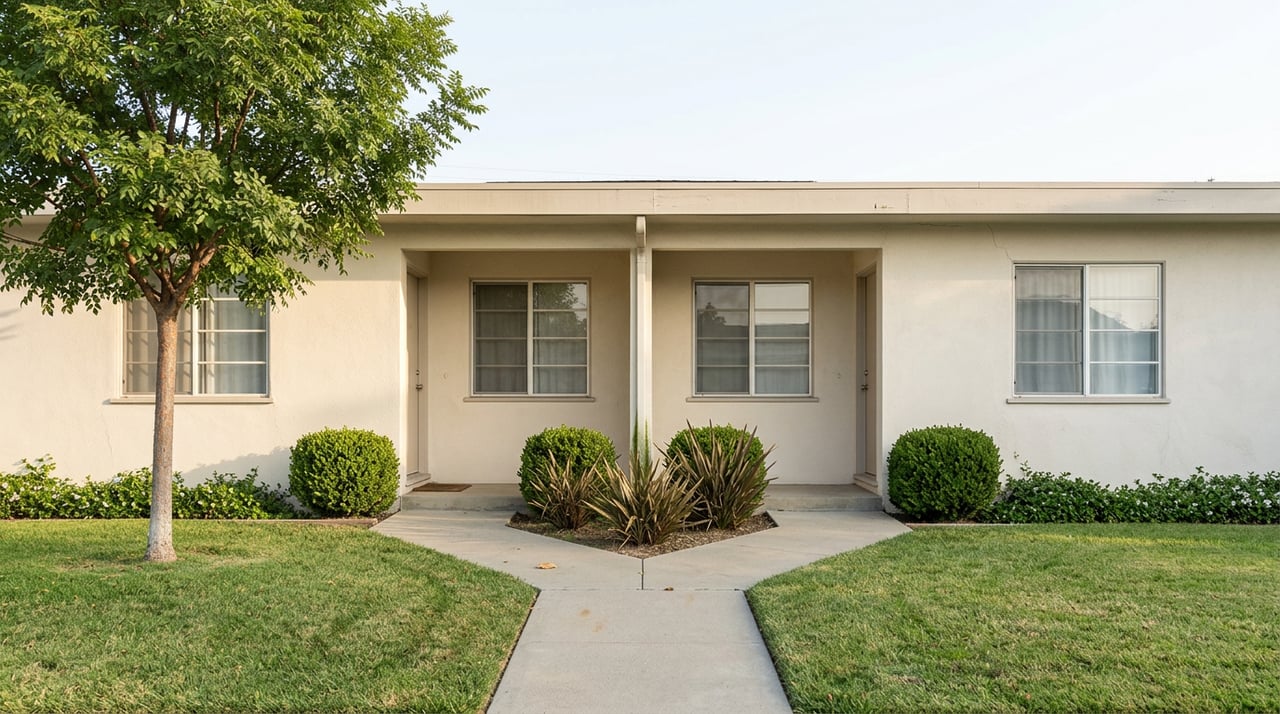
Two triplexes sit two blocks apart in Mountain View. Same square footage, same unit mix, same asking price per door. One was issued its certificate of occupancy in 1993. The other went up in 1998. On paper, they look like the same investment. In practice, one of them can raise rent by whatever the market allows next year, and the other is locked into a formula set by a city committee that meets to decide a single percentage every spring.
That gap is not a quirk. It is the entire economics of small multifamily property in Mountain View, and it rarely shows up in a listing sheet.
Mountain View's Community Stabilization and Fair Rent Act, known as Measure V when voters approved it in November 2016, governs what a landlord can charge and how a tenant can be removed. Most buyers who look at a duplex or triplex here treat the ordinance as background noise, something a property manager will sort out after closing. That is a mistake, because the ordinance does not care who owns the building. It attaches to the property itself, and it is structured as a sequence of gates. Skip any one of them during due diligence and your rent projection is a guess dressed up as a number.
Count the Units Before You Count the Rent
The first gate is not the calendar. It is the unit count.
Mountain View's rent stabilization and eviction protections apply to multi-family rental properties with three or more units. A true duplex, two units under one roof, generally falls outside that framework entirely, regardless of when it was built. That does not mean a duplex is unregulated. California's statewide Tenant Protection Act, AB 1482, can still apply to buildings 15 years or older that are not otherwise exempt, capping annual increases at 5 percent plus local inflation or 10 percent, whichever is lower. But the local ordinance, with its committee-set annual ceiling, only starts to matter once a property crosses the three-unit threshold.
This is worth sitting with before you tour a fourplex versus a duplex at the same price point. Adding one unit to a property does not just add rent. It can add a legal ceiling on that rent.
The Two Calendar Dates That Split the Rest
Once a property clears the three-unit threshold, the construction date takes over. Two dates matter, and they sort buildings into three outcomes.
| Coverage tier | Construction date | Rent cap applies | Just-cause eviction applies |
|---|---|---|---|
| Fully covered | On or before February 1, 1995 | Yes | Yes |
| Partially covered | Between February 1, 1995 and December 23, 2016 | No | Yes |
| Exempt from CSFRA | After December 23, 2016 | No | Only under statewide AB 1482, if applicable |
A building built in 1994 carries both the rent cap and the just-cause protections. A building built in 2010 still requires just cause for eviction, but the owner can raise rent to whatever the market bears. A building built in 2018 sits outside the local ordinance altogether. Same city, same zoning, three completely different rent trajectories, and the only variable is a certificate of occupancy date that most purchase agreements never ask you to verify.
Base Rent Isn't Today's Rent, It's 2015's Rent
Here is where buyers get caught even when they know the age of the building. For fully covered properties, the ordinance does not start its math from whatever the current tenant is paying today. It starts from a fixed reference point: the rent actually charged on October 19, 2015. For any tenancy that began after that date, the starting point is the initial rent at move-in. From there, the owner can raise rent once every 12 months by the Annual General Adjustment, and nothing more, unless they petition the city's Rental Housing Committee for an exception.
A 2022 clarification from that committee shows how literally this rule gets applied. During the pandemic, some landlords had offered temporary rent discounts to keep units filled. A year later, several tried to restore the original, higher rent all at once, arguing the discount was a temporary concession and the real base rent was the pre-discount number. The Rental Housing Committee ruled otherwise. The base rent was what the tenant was actually paying, discount included, and any increase back to the old number had to happen through the normal annual adjustment process, not in a single step.
The lesson transfers directly to a buyer's underwriting. If a seller hands you a rent roll showing what a unit is "supposed to" rent for, or what it rented for before a lease renewal discount, that number may not be the legal base rent at all. The property's real income ceiling is whatever was actually collected, plus a chain of annual adjustments going back to 2015. Pulling that history, not the current lease, is the only way to know what you are buying.
The Ceiling Moves, and That Movement Is Its Own Risk
The Annual General Adjustment is not a fixed percentage. It is recalculated every year based on the Bay Area Consumer Price Index, with a floor of 2 percent and a ceiling of 5 percent. The Rental Housing Committee's own adopted numbers show how much that ceiling has swung in just the last few years.
- 2020 to 2021: 2.9 percent
- 2021 to 2022: 2.0 percent
- 2022 to 2023: 5.0 percent
- 2023 to 2024: 5.0 percent
- 2024 to 2025: 2.4 percent
- 2025 to 2026 (currently in effect): 2.7 percent
Landlords who don't use the full adjustment in a given year can bank it and apply it later alongside a future year's increase, though banked increases carry extra notice requirements and can be challenged through a tenant hardship petition. A buyer modeling five years of rent growth on a fully covered property is not modeling a stable trend line. They are modeling a range that has swung between 2.0 and 5.0 percent in just the past six adjustment cycles, with no guarantee which end of that range shows up next.
If Your Plan Is to Rebuild, Budget for More Than Construction
Some buyers look at an older, fully covered building and see a teardown opportunity rather than a rental hold. That plan carries its own cost structure. As of a 2023 city staff memo presented to the Mountain View City Council, close to 1,000 rent-stabilized units in the city had been demolished or were slated for demolition since 2012 to make way for roughly 30 new residential developments. State law, specifically SB 330, requires that any protected units lost to redevelopment be replaced without a net loss of affordable housing, and that displaced lower-income tenants receive relocation assistance along with a right to return to the redeveloped property at an affordable rate. The city's own housing director told the council that only about 40 percent of the CSFRA units lost were coming back as affordable rather than market rate.
None of that shows up in a construction budget. It shows up in a timeline, a relocation line item, and a set of obligations that follow the site rather than the seller.
What to Actually Check Before You Write an Offer
Before an offer goes in on any Mountain View property with three or more units, the due diligence list should include:
- The certificate of occupancy date, to determine which of the three coverage tiers applies
- Whether the property is currently registered with the city's Rental Housing Committee, which oversees compliance
- A full rent history for each unit back to October 19, 2015, not just the current lease
- Any record of banked increases or pending petitions filed with the Rental Housing Committee
- Whether any unit has been the subject of a rent overcharge complaint, which can create a refund obligation that transfers with the sale
The city's Rent Stabilization Division, based at 500 Castro Street, maintains records on registration and coverage status and can confirm specifics for a given address. That single phone call or records request is cheaper than discovering the ceiling on your pro forma after you already own the building.
Some of the older multi-unit stock that still trades in Mountain View sits in neighborhoods like Shoreline West, where listings occasionally surface small apartment buildings dating back to the early 1950s alongside far newer construction on the same street. The age spread within a single neighborhood is exactly why the build date has to be checked property by property rather than assumed from the block.
What a small multifamily property in Mountain View is actually worth depends less on comparable rents down the street and more on three questions: how many units, when it was built, and what the last tenant really paid.
Frequently Asked Questions
Does this apply if I plan to live in one unit of a duplex and rent the other? The local rent cap and just-cause framework apply to multi-family properties with three or more units, so a true two-unit duplex generally falls outside CSFRA coverage regardless of owner occupancy. Statewide protections under AB 1482 may still apply depending on the building's age and other exemptions.
What about a single-family home with an ADU I plan to rent? Single-family homes are treated separately from the multi-family framework this ordinance targets. Confirm current treatment of ADUs with the city's Rent Stabilization Division before finalizing your underwriting, since rules in this area continue to evolve.
How do I confirm coverage status for a specific address before I write an offer? The City of Mountain View's Rent Stabilization Division can confirm registration and coverage status for individual properties. This should happen during your inspection period, not after close of escrow.
Does renovating the building remove the rent cap? Capital improvements can support a petition to the Rental Housing Committee for an above-guideline rent increase, but they do not remove coverage. The building's construction date and unit count remain the controlling facts.
Buying a small multifamily property in Mountain View means underwriting a legal structure as much as a physical building. If you are weighing a duplex, triplex, or fourplex here, or considering a 1031 exchange into this market, Naoko Amaya can walk through the coverage check, the rent history pull, and the real numbers before you write an offer. Let's Connect.
