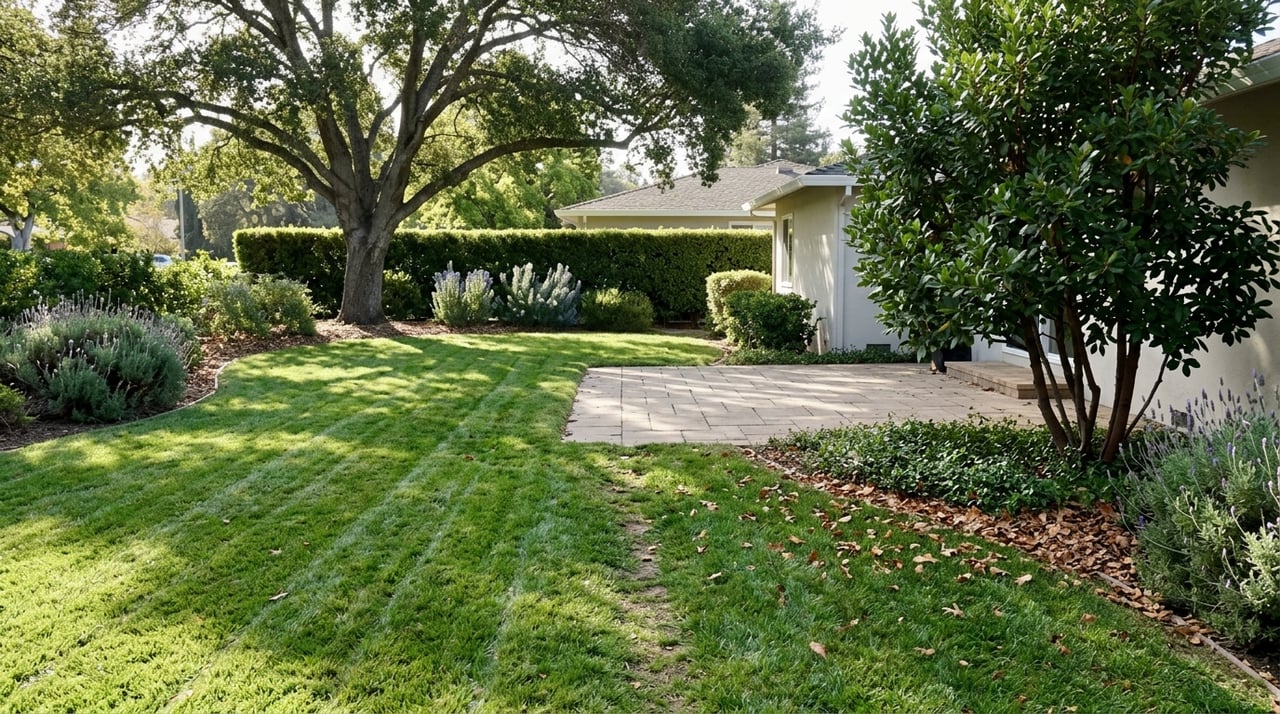
If you pulled up Los Altos on a housing data site this summer, you saw a number that looks like relief: the median sale price fell 13.8 percent year over year, to $4.2 million, over the three months ending May 2026. For a market that spent the last several years setting records, that reads like a market finally cooling off. A buyer scanning that number might reasonably conclude that Los Altos got cheaper.
It didn't. Over that same window, the median sale price per square foot in Los Altos rose 3.6 percent, to $1.94K. Those two numbers cannot both describe a market where homes are simply worth less than they were a year ago. They describe a market where the mix of homes changing hands shifted, and where the price of the underlying dirt kept climbing even as the price of the typical transaction dropped.
This matters if you're weighing Los Altos against other Peninsula cities and using the median as your yardstick. The median tells you what the middle transaction looked like. It does not tell you what a given square foot of house, or a given square foot of lot, actually cost. In a city where zoning caps how much house you can put on a parcel no matter how much money you bring to the table, that second number is the one that reflects real value. The first one just reflects what happened to sell.
What Actually Changed: The Sales, Not the Prices
A median moves for two reasons. Either the price of comparable homes changed, or the population of homes selling changed. When smaller houses, older houses, or houses on tighter lots make up a larger share of a given quarter's closings, the median drops even if every individual seller got a stronger price than the last comparable sale in that segment.
Los Altos in spring 2026 looks like the second case. Transaction volume actually rose during this window, with 103 homes sold in May compared to 82 a year earlier. More sales, softer median, firmer price per square foot: that combination points to a market absorbing a different kind of inventory, not a market where buyers gained leverage. If the same mix of large estates and modest ranches had traded in the same proportions as last year, the median would not have moved the way it did.
This is also why price per square foot is the more stable number to anchor on if you're trying to understand what Los Altos actually costs right now. It adjusts for the fact that the average square footage of what's selling changes constantly, whether because of new construction, teardown activity, or a wave of smaller lot-split parcels entering the market. The median price does not make that adjustment. It just reports whatever landed in the middle.
One City, Two Very Different Medians
The citywide number also flattens real differences between parts of Los Altos that behave nothing alike. Compare Central Los Altos and Old Los Altos over the three months ending June 2026:
| Area (3-month window ending June 2026) | Median sale price | YoY change in price | Price per square foot | YoY change in $/sf |
|---|---|---|---|---|
| Central Los Altos | $5.4M | +7.7% | $1.92K | +11.6% |
| Old Los Altos | $3.7M | +6.4% | $1.52K | +9.9% |
Neither of these neighborhoods shows anything close to a 13.8 percent decline. Both show meaningful gains in price and in price per square foot. The citywide drop only shows up once you blend these segments with everything else selling across Los Altos, including North Los Altos, South Los Altos, and the condo and townhome market, which trades on a much thinner and choppier set of comps than single-family homes do.
If you're comparing neighborhoods and someone hands you the citywide median as evidence that Los Altos softened, ask which streets actually sold. The number is real. It just isn't describing the neighborhood you're likely considering.
Why the House Barely Matters
The deeper reason price per square foot holds up better than the sale price is that Los Altos strictly limits how much house you're allowed to build on a given lot, regardless of what a buyer is willing to spend. The city's floor area formula caps total floor area at 35 percent of net lot area for parcels up to 11,000 square feet. Above that, the allowance is 3,850 square feet plus 10 percent of the lot area beyond 11,000 square feet. A buyer with more money to spend cannot simply build a bigger house on a standard lot. The ceiling is fixed by the parcel, not by the budget.
Los Altos also updated its tree protection rules in 2024 under Ordinance No. 2024-506, which protects any tree 12 inches or greater in diameter measured 48 inches above grade. On a lot with mature landscaping, that ordinance can further shrink the buildable footprint beyond what the floor area formula alone would allow.
Put those two rules together and you get a market where the house is almost a fixed quantity once you know the lot size, and the price a buyer pays is really a bid on the lot itself. That's why price per square foot tracks land value more honestly than the total sale price does. The total price depends on which size of house happened to sell that quarter. The per-square-foot price reflects what buyers will pay for a fixed, regulated unit of buildable land, and that number kept rising in Los Altos even while the median transaction size shrank.
The Vote That's Quietly Changing the Comps
There's a second force reshaping what's actually for sale in Los Altos, and it traces back to a specific city council vote. In 2024, the Los Altos City Council adopted an ordinance implementing California's SB9, the state law that lets qualifying single-family lots be split into two parcels or developed with a second unit through a ministerial process. According to the Los Altos Town Crier's reporting on the ordinance, the council approved the measure on a 4-1 vote, with Councilmember Lynette Lee Eng dissenting. As of that May 2024 staff report, 18 applications had already been submitted under SB9, though only nine of those requested a full urban lot split.
The detail that matters most for anyone reading market data going forward: the council chose to eliminate floor area ratio as a factor in determining house size for SB9 projects, and dropped the daylight plane requirements that used to shape approvals. That means SB9 units on split lots can be smaller, denser, and structured differently than the FAR-governed homes that make up the rest of the city's housing stock. As more of these smaller-footprint parcels close, they enter the same MLS dataset as every other Los Altos sale, and they pull the median toward a smaller, cheaper transaction even though nothing about the value of a standard, non-split lot changed.
This is the same mechanism showing up at a regional scale. Palo Alto Weekly's Q1 2026 review of Peninsula sales found that large parcels of 20,000 square feet or more were drawing multiple offers and often selling $1 million to $2.5 million over list, with both homeowners and investors actively pursuing SB9 lot splits on those bigger parcels. The reporting also noted that Los Altos, after a 30 percent surge in 2025, was seeing prices recalibrate. Bigger lots are getting bid up for their split potential while a wider range of smaller, sometimes newly created parcels enters the sales mix underneath them. Both things are true in the same market at the same time, which is exactly how a median can drop while land value climbs.
What This Means If You're Comparing Los Altos to Its Neighbors
If you're deciding between Los Altos and a nearby city, three questions will tell you more than the headline median ever will. First, ask whether the comps your agent is showing you sit above or below 11,000 square feet, since that threshold changes the floor area math entirely. Second, ask whether any of the recent comparable sales originated from an SB9 split, since those parcels carry different size rules than a standard lot and will understate what a full, unsplit lot is worth. Third, look at price per square foot for the specific pocket of the city you're considering rather than the citywide figure, since Central Los Altos and Old Los Altos are telling two different stories in the same data window.
None of this means Los Altos is more or less affordable than the headline suggests. It means the headline is measuring something narrower than most readers assume, and the number that actually reflects what you'd pay for comparable land kept moving in the opposite direction.
Frequently Asked Questions
Does the falling median mean Los Altos is a buyer's market right now? Not based on the price-per-square-foot trend. A falling median alongside a rising per-square-foot price points to a shift in what's selling, not a shift in what buyers are willing to pay for comparable land.
Why would the city remove floor area ratio from SB9 project calculations? The council's 2024 vote followed direction from the planning commission and was intended to simplify approval for qualifying two-unit and lot-split projects, though it means SB9 parcels now follow different sizing rules than standard R1 lots.
Should I expect more SB9 lot splits to show up as comps near me? As of the city's 2024 staff report, 18 applications had already been filed, with nine requesting full lot splits. That pace suggests more split-lot sales will continue entering the comp pool over time, which is worth flagging to whoever is pricing your home or evaluating a purchase.
If you're trying to make sense of what a specific Los Altos block, lot, or listing is actually worth right now, the citywide median won't get you there on its own. Naoko Amaya works these micro-markets street by street, with access to Compass's off-market Private Exclusives when the right comp hasn't hit public data yet. Let's Connect and look at what your particular lot, not the headline number, is really telling you.
